
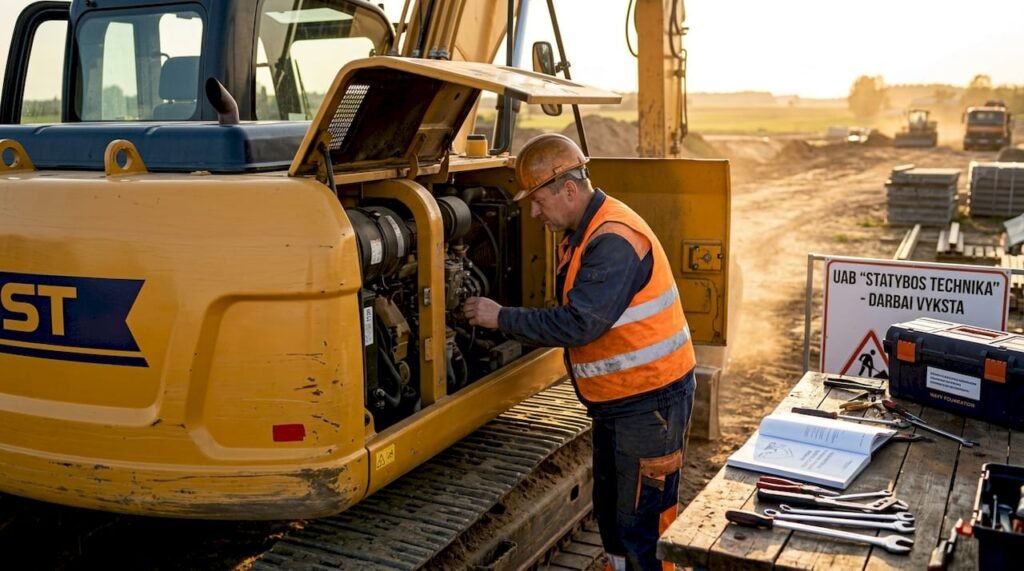
Reducing equipment downtime is a direct factor in work efficiency and construction project profitability, determined not only by the speed of repairs, but also by organized prevention and standardized maintenance procedures. In the industry, this process is often called MTTR (Mean Time To Repair) management, but for builders and equipment owners, the most important practical aspect is how long the equipment is idle and not working. Research shows, that proper prevention and scheduled component inspections can reduce downtime to 30 %. In this article, you will find specific tips for reducing technical downtime, based on 2026 data and real-world industry experience.
1. Tips for reducing technical downtime: understand the causes of failures
The time to repair a fault directly depends on how quickly and accurately the cause of the fault is identified. About 50-60% of % construction equipment faults are due to component wear and tear, rather than catastrophic equipment failure. This means that the majority of downtime situations are predictable and avoidable if you know what to look for.
The most common causes of construction equipment failures are divided into several groups:
- Mechanical wear and tear. Pins, bushings, sliders and hydraulic hoses wear out quickly, especially during heavy use. JCB excavator boom and bucket joints require regular inspection, as their wear directly affects the efficiency of the hydraulic system.
- Ignoring symptoms. Operators often notice the first signs of a malfunction, such as unusual noises or slowed hydraulic performance, but continue working. Every day lost in this situation prolongs future repairs.
- Ineffective diagnostics. Mechanically replacing a part without determining the exact cause is one of the most common mistakes. Systematic analysis of the cause of failure reduces the likelihood of repeated failures and shortens the overall repair time.
- Improper maintenance. The maintenance intervals recommended by CAT and Volvo equipment manufacturers are not conditional. Failure to comply with them directly correlates to more frequent and longer-lasting failures.
Failure analysis techniques, such as a cause-and-effect diagram or the simple five-why method, help to quickly identify the real problem. These methods reduce repair time because mechanics don’t waste time trying solutions one after the other.
2. Advanced diagnostics and prevention: how to reduce the number of failures
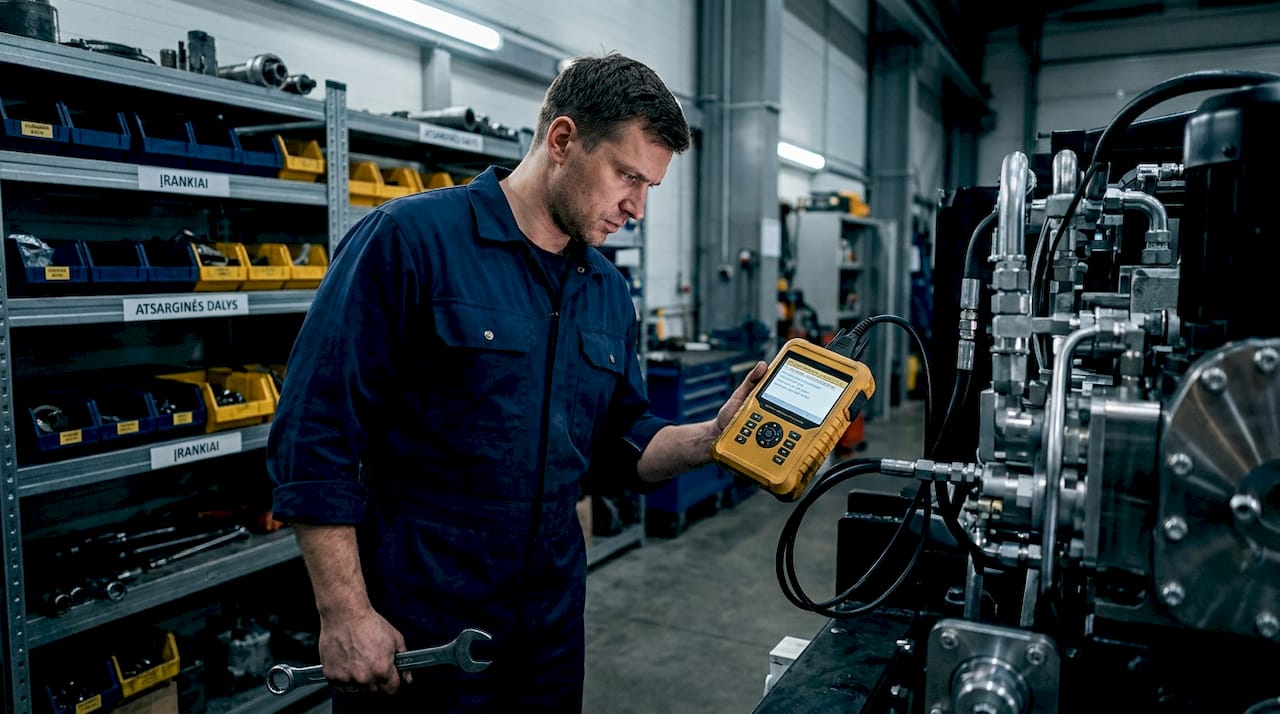
Predictive maintenance, also known as „Maintenance 4.0„, is a data-driven approach that transforms reactive repairs into planned ones. Applying the principles of “Maintenance 4.0” can reduce the number of failures by up to 25 %, repair time by up to 20 % and operating costs by up to 15 %. These figures show that the investment in diagnostic systems pays for itself in a few months.
Modern diagnostic systems used in JCB, CAT and Volvo equipment monitor engine temperature, hydraulic fluid pressure, vibration levels and other parameters in real time. In the transport and construction machinery sector These systems can signal an impending failure days or weeks in advance, allowing maintenance to be planned in advance rather than responding in emergency mode.
Practical prevention steps that directly reduce downtime:
- Periodic technical inspection according to the manufacturer's schedule, including inspection of hydraulic hoses, pins and bushings.
- Changing oils and filters on time, as contaminated oils accelerate component wear.
- Use of diagnostic devices such as OBD scanners or manufacturer-specific tools before each major stage of work.
- Periodic inspection of construction machinery according to a structured checklist that covers all critical nodes.
Professional advice: If the equipment is used intensively, for example more than 8 hours per day, shorten the maintenance intervals by 20-30 % compared to the manufacturer's recommendations. This is especially true for the hydraulic system of JCB 3CX and CAT 320 excavators.
3. Development of standardized repair processes
Standardization is a key tool for reducing downtime because Most often, it is not the repair process that prolongs the downtime, but preparation, logistics and chaotic work organization.. This means that even an experienced mechanic can lose hours searching for tools, waiting for parts, or not knowing where to start.
A standardized verification sequence should include the following steps:
- Visual inspection. First, check the hydraulic hoses, connections and seals for leaks. On Volvo and CAT equipment, hydraulic leaks are often the first sign of a more serious problem.
- Electrical system check. Fuses, relays and sensors should be checked before mechanical disassembly is attempted, as many symptoms are of electrical origin.
- Hydraulic system pressure measurement. Use a pressure gauge to check that the pressure meets the manufacturer's specifications.
- Engine diagnostics. Connect a diagnostic tool and scan for error codes before starting any mechanical work.
- Component inspection by symptom. Only after completing the previous steps, move on to the specific component that most closely matches the symptoms of the failure.
A pre-prepared set of tools and spare parts is another important element of standardization. For each type of equipment, a separate bag should be prepared with the most commonly replaced parts: seals, filters, pins and bushings. This eliminates waiting time, which can be a significant part of the total troubleshooting time.
| Stage | Standardized action | Saves time |
|---|---|---|
| Diagnostics | Reading error codes before dismantling | 30–60 minutes. |
| Preparing tools | Pre-assembled bag | 20–40 minutes. |
| Parts logistics | Spare parts warehouse on site | 1–4 hours. |
| Procedures | Written troubleshooting algorithm | 15–45 minutes. |
Professional advice: Create laminated troubleshooting algorithms for each type of equipment and keep them inside the cab. An operator or mechanic, even without experience with a specific model, will be able to start diagnostics correctly.
4. Operator training and work discipline
The human factor is one of the most underestimated factors in reducing downtime. Operator training reduces equipment downtime, because specialists identify faults faster and can fix them without the need for maintenance assistance. This means that investing in training directly reduces the number of service calls.
Operator training should cover the following areas:
- Daily inspection before work. The operator must be able to check the oil level, hydraulic fluid level, condition of the tracks or wheels, and visually inspect the equipment before each shift.
- Early recognition of symptoms. Unusual noises, smoke, vibrations or changes in handling should be reported immediately. JCB 3CX operators, for example, are often the first to notice hydraulic hose leaks, which, if not caught in time, can turn into costly repairs.
- Correct use of technique. Overloading, sudden maneuvers, and improper operation accelerate wear. Training in correct working techniques directly reduces the frequency of component failures.
- Setting priorities in case of failure. The operator must know when it is possible to continue working with a minor fault and when the equipment must be stopped immediately.
Work regime discipline also includes a clear division of responsibilities within the team. When everyone knows their role in the event of a breakdown, a situation is avoided where everyone looks at each other and no one takes action. A consistent training plan and disciplined work regime improves the efficiency of repair processes and reduces the so-called „gray time”, when the equipment is standing still but no one is actively working.
5. Rapid response algorithm: where to start in case of a failure
Starting troubleshooting quickly and correctly saves more time than any other action. Simple steps like checking and cleaning fuses, sensors and connectors, allows you to significantly shorten the time for diagnosing a fault and avoid high repair costs. Specialists who arrive at the service station already knowing the cause of the fault save an average of several hours.
Quick response algorithm in case of construction equipment failure:
- 1 minute. Stop the machine in a safe place and turn off the engine. Visually inspect for smoke, leaks, or obvious mechanical damage.
- 5 minutes. Check the fuses and relay box. Many electronic faults that seem complicated can be solved by replacing a blown fuse.
- 10 minutes. Connect a diagnostic tool and read the error codes. JCB, CAT and Volvo equipment have advanced diagnostic systems that pinpoint the exact location of the fault.
- 20 minutes. If the fault is not identified, check the hydraulic hose connections, sensor contacts and the condition of the electrical wiring. Faulty sensors often mimic other faults.
- After 30 minutes. If the fault is still not identified, contact the service with an accurate description of the symptoms and error codes. This will reduce the service diagnostic time.
In a manufacturing environment, uncontrolled switching between work stages can result in 15–20 % of lost production time. In the construction sector, an analogous phenomenon is the chaotic transition from one job to another during a breakdown, when the team loses time on unclear priorities. A standardized algorithm eliminates this time loss.
6. Spare parts logistics and warehouse management
Waiting for parts is one of the main reasons for extended downtime, especially on construction sites located far from the city. Effective spare parts management means that the most frequently replaced parts are always on hand, and less frequently replaced parts can be obtained in minimal time.
The minimum set of spare parts for a construction site should include: hydraulic seals and O-rings, filters (oil, hydraulic, air), fuses and relays, pins and bushings for the most commonly used components, and track chains or wheels, depending on the type of equipment. Eskadalys offers both original JCB, CAT and Volvo parts, as well as high-quality alternatives that allow you to equip the warehouse without exceeding the budget.
Warehouse management principles that directly reduce downtime: First, determine which parts are replaced most frequently on your specific equipment and keep at least double the quantity. Second, create a simple inventory list and check it monthly, replenishing used parts. Third, establish a relationship with a reliable supplier who can deliver parts within 24 hours, because even the best-planned warehouse sometimes does not have the part you need.
7. Documentation and analysis of fault history
Documenting fault history is an investment of time that pays for itself many times over. Each recorded fault, its cause, parts used and repair time form a database that allows you to predict future faults and optimize maintenance schedules.
The simplest documentation format includes: equipment identifier, date and time of failure, symptom description, identified cause, parts replaced, and repair duration. Even a simple Excel file with this data over a 6-month period reveals clear patterns. For example, if the hydraulic hoses of a particular equipment are replaced every 3 months, a preventive replacement can be scheduled every 2.5 months and avoid an emergency failure.
Data-driven diagnostics not only reduce the number of failures, but also optimize the repair process, plan spare parts and service visits in advance. This is especially important for large construction companies with multiple equipment units, where unplanned failures can stop the entire project.
8. Organizing teamwork during a breakdown
Teamwork during troubleshooting often seems active, but in reality it creates so-called „gray time” when everyone is working but no one is coordinating the process. Unclear priorities and chaos increase troubleshooting time more than the technical failure itself.
Effective teamwork during a breakdown is based on three principles. First, one responsible person coordinates the entire process and makes decisions. Second, each team member has a clearly defined role: one performs diagnostics, another prepares tools and parts, and a third coordinates logistics. Third, communication follows a set protocol: every 15 minutes, the responsible person receives an update on progress.
In the construction sector, where project deadlines are critical, the efficiency of the troubleshooting team directly affects financial results. One hour of technical downtime can mean losses of several thousand euros, especially if the activities of other workers depend on it. Therefore, organizing teamwork is not just a convenience, it is a financial decision.
Main conclusions
The most effective reduction in equipment downtime is achieved by combining prevention, standardized diagnostics, and a clear team action plan, not just faster repairs.
| Point | Details |
|---|---|
| Prevention reduces failures | Scheduled inspections allow you to reduce the probability of failures by up to 30%, avoiding emergency repairs. |
| Pre-dismantling diagnostics | Scanning error codes and checking fuses saves 30-60 minutes per fault. |
| Standardized processes | Pre-built algorithms and toolkits eliminate chaotic preparation time. |
| Operator training | Trained operators identify faults earlier and reduce the number of service calls. |
| Parts logistics | An on-site warehouse with commonly replaced parts eliminates waiting times of several hours. |
My view: what practice really teaches
When I work with construction equipment owners, I notice a recurring pattern: everyone knows that prevention is better than repair, but few people systematically apply it. Most often, it is not a lack of knowledge, but a problem of priorities. When the equipment is working, no one wants to stop it for inspection. When it breaks down, everyone wants to fix it as soon as possible. The gap between these two situations is where the most time and money is lost.
In my experience, it is not the technology itself or the most expensive diagnostic tools that make the biggest difference, but the simplest organizational decisions. A team that has a laminated troubleshooting algorithm inside the cabin responds faster than a team with the most expensive tools but no clear procedure. A warehouse with 20 most frequently replaced parts saves more time than any other investment decision.
I also find that documentation is the most underrated tool. Builders who keep a history of failures can predict when a particular component will fail after 6 months. It's not magic, it's simple data usage. If your machinery has the same failure every 3 months, the problem is not the failure, the problem is that no one is looking for the real cause.
Finally, I would like to emphasize that quick troubleshooting is not an end in itself. The goal is minimal downtime over the entire life of the equipment. This is achieved not by rushing to repair, but by systematically reducing the frequency of failures and improving preparation for each possible failure.
— Camille
Eskadylys: reliable parts faster than you expect
The time it takes to resolve a problem directly depends on whether the required part is on hand. Eskadalys offers a wide range of parts for JCB, CAT and Volvo construction equipment, including both original parts and high-quality alternatives that meet the manufacturer's specifications. Fast delivery and professional advice mean that you will receive the right part in minimal time, whether you are looking for hydraulic seal, or a more complex node.
Eskadalys specialists help identify the right part based on the vehicle model and fault symptoms, saving you diagnostic time. Construction machinery parts The range includes everything you need for standardised repairs and preventative maintenance. For more technical advice and maintenance guides, please visit Blog shard, where practical information for builders and equipment owners is regularly published.
FAQ
What is the fastest way to diagnose a technical fault?
The quickest way is to connect a diagnostic tool and read the error codes, after checking the fuses and relay box. These two steps eliminate most possible causes in 10-15 minutes and allow you to focus on the real problem.
How often should preventive maintenance of construction equipment be performed?
Preventive maintenance is carried out according to the manufacturer's specified intervals, but in case of intensive use it is recommended to shorten them by 20–30 %. In JCB, CAT and Volvo equipment, the hydraulic system should be checked at least every 250 operating hours.
Why does troubleshooting take longer than the repair itself?
Most often, downtime is caused by preparation, logistics and chaotic work organization, not by the technical repair itself. Standardized processes and pre-prepared tools and parts can reduce this "gray time" several times.
Does operator training really reduce downtime?
Yes, because trained operators identify failure symptoms earlier and can perform simple diagnostics without the help of a mechanic. This directly reduces the number of service calls and shortens the time from the detection of a failure to the start of its elimination.
What parts are worth keeping in stock at a construction site?
It is recommended to keep hydraulic seals, O-rings, filters, fuses, pins and bushings for commonly used components on site. These parts are replaced most frequently and their absence can extend troubleshooting time by several hours.
